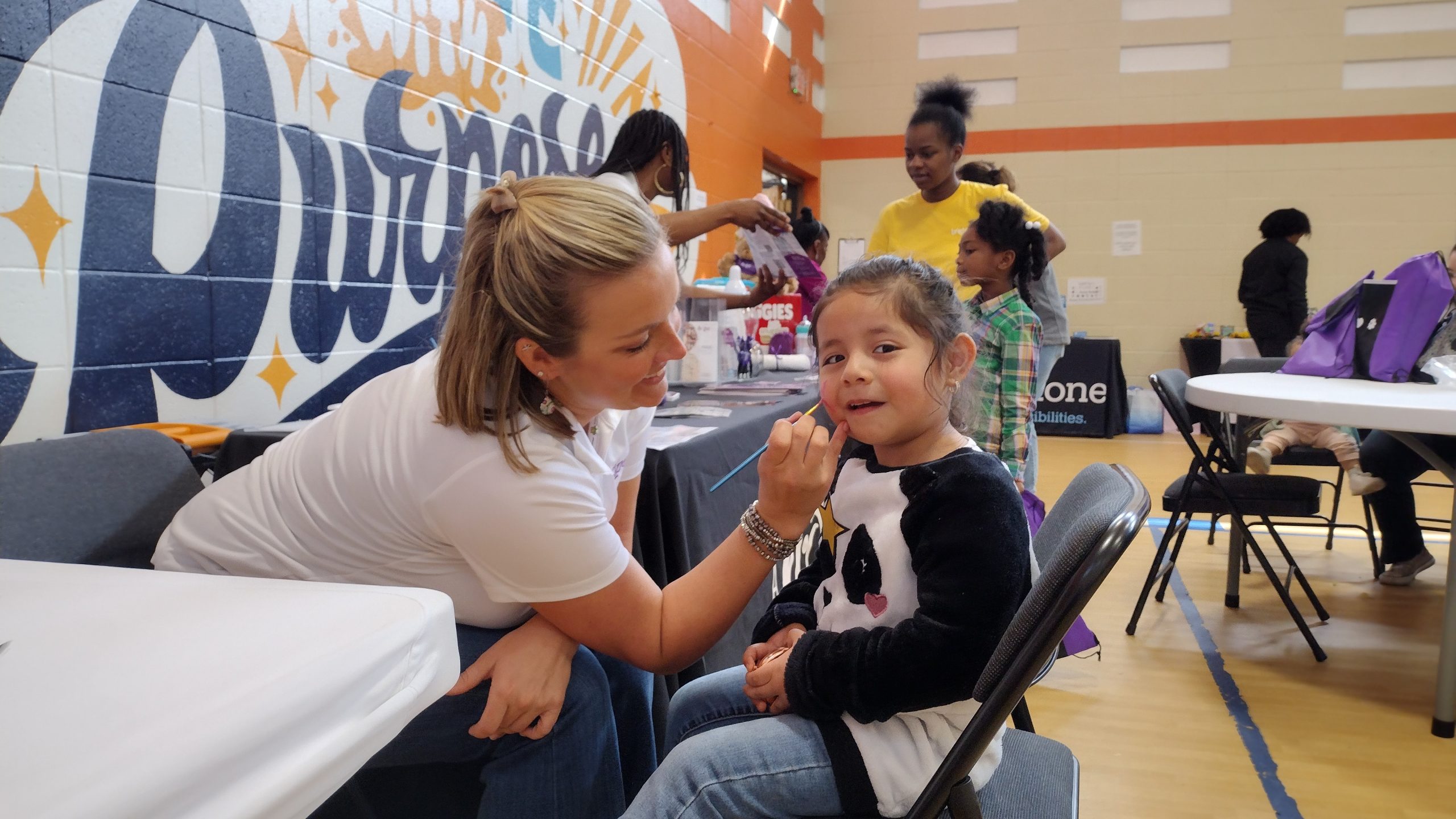
More than 200 families attended a community baby shower at Iris Family Support Center’s Family Resource Center (FRC) in Fort Wayne, many arriving hours early and standing in a line wrapped around the building. They came for diapers, hygiene products and a little something extra.
“We had no idea it would be that big. Families came dressed in their best clothes to get professional maternity photos. It was beautiful. For many of them, it was the first time they’d had anything like that – a moment to feel celebrated,” said Whitney Craig, Iris’s marketing and communications director.
Iris’s team knew the organization was well-positioned to make a deeper impact in Fort Wayne, but they didn’t expect just how quickly the need for early childhood support would grow or how powerfully the community would respond.
Through Early Years Initiative, Iris expanded two programs supporting children and families from pregnancy through early childhood. One of those is the FRC, which opened in 2023 in Fort Wayne’s 46806 zip code, where infant mortality rates are among the highest in the state.
“We intentionally placed the FRC in a neighborhood where families could walk to access support,” said Jessica Hicks, Iris’s community services vice president.

The FRC, which supports about 250 children, offers prenatal education, safe sleep classes and parenting education, as well as practical support like diapers, hygiene products and developmental screenings. But what sets the center apart is how its programming builds trust with multilingual and multicultural families through translation and meaningful connection.
More than 70% of the families that visit the center speak a language other than English – Spanish, Burmese, Haitian Creole, French, Rohingya and Swahili, to name a few. Cultural responsiveness is built into how the organization operates, with half of the center’s radio ads created in Spanish and printed materials available in multiple languages.
“We’ve had to rethink everything, from hiring practices, to how we design flyers, to where we advertise. When families walk in the door, we want them to feel like this is their space,” Craig said.
That intentionality extends to Iris’s long-standing Healthy Families Program, which has served Allen County since the 1990s. Expanded through Early Years Initiative, the program now serves about 500 children and includes the Parents as Teachers (PAT) curriculum, an evidence-based model that supports families from the third trimester of pregnancy through age three.
The Healthy Families team visits families at their homes, providing support with child development but also job searches, education, mental health referrals and more. That wrap-around approach is especially important for non-English-speaking families who may struggle to access services due to language or cultural barriers.
“Our team was so excited when we were able to bring in PAT. It’s practical and empowering. One part teaches families how to make developmental toys using items they already have at home. That’s a game-changer for a family that might not be able to afford new toys. We’re trying to reduce stressors, because when you reduce stress for a parent, you reduce risk for the child. That’s prevention work at its best,” Hicks said.
Team members reflect the communities they serve and Iris regularly offers the team cultural competency training to ensure families feel respected and heard. Sessions have included ways to support the Burmese community and how to better communicate with Spanish-speaking populations.
While both programs target families from pregnancy through early childhood, Iris takes a flexible, no-wrong-door approach to care. If a family enters the FRC but doesn’t meet the age cutoff for Healthy Families, the team refers them to other Iris programs or trusted partners in the community.
“It’s not about who we can serve. It’s about how we make sure every family gets connected to someone who can help. No one gets turned away,” Craig said.
Early Years Initiative has transformed their programs, they said.

“It validates the work we’re doing. Social work is hard. You don’t do it for the money. But when our team sees that people believe in them and in the families we serve, that matters. That fuels us,” Hicks said.
“This is what prevention looks like,” Craig added. “It’s support from day one, and it’s changing lives.”
No comment yet, add your voice below!