
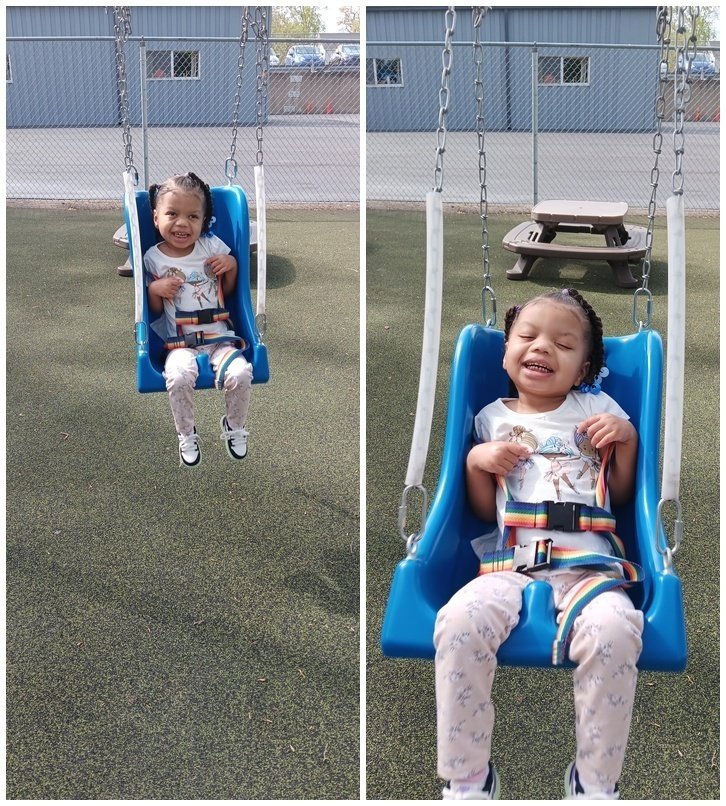
When the little girl with Down Syndrome took her first steps, cheers and applause filled the classroom. Not just from the staff, but from her peers, too. It was a big moment for everyone, said Cherish Edwards, executive director at the Center for Possibilities in northwest Indiana.
Through Early Years Initiative, the Hobart program is transforming what early education can look like for children with special needs. The program, which serves children ages two to six, has long provided critical support for families whose children have developmental, physical or medical needs that typical preschool programs may not be equipped to accommodate.
Until recently, the center operated with just two classrooms and could serve up to 18 students. Now, the program has expanded – adding a third classroom, enlarging its two-year-old room and increasing its capacity to 31 students. The expansion created 13 additional seats in a program that often has a waitlist.
“Some of these kiddos, if we’re not going to meet their needs, they’re not going anywhere,” Edwards said. “They’re staying home with nurses or respite workers, without the opportunity to socialize or learn the skills they could be developing.”
The program supports a wide range of children, including many on the autism spectrum, as well as children with cerebral palsy, seizure disorders, chromosomal microdeletions and other complex medical needs. While Indiana requires a 10-to-1 student-teacher ratio for this age, the center maintains significantly lower ratios: around 3-to-1 in its two-year-old room and 5-to-1 in its older classrooms to ensure the children get the support they need.

This individualized approach supports children with varying levels of need. One child who came to the center at age 3 had the developmental function of a 3-month-old. Staff worked with her on lifting her head and turning it. Others arrive pre-verbal, and teachers may use sign language to support their communication. The center prepares children by teaching basic classroom routines and fostering social-emotional development.
“Peer pressure can be a good thing. We’ve seen kids overcome feeding sensitivities because they see everyone else eating the same food. We had a foster child who, after just a week, started using the toilet because all the other kids were,” Edwards said.
The center runs year-round, something that’s especially valuable for children on the autism spectrum who benefit from structure and familiarity.
“Continuity of care is so important. We’re a small team – six teachers, an assistant director and myself – and the kids see all of us every day. Even when they move to a different classroom, the transition is smooth because they already know the teachers,” Edwards said.
That close-knit environment creates lasting bonds with families. Some children begin the day they turn two and stay until kindergarten. One family, whose daughter will graduate from the program this summer, has been part of the center for six years.
“We had her brother first, and her mom was pregnant with her (daughter) when he started. It’s hard to say goodbye when we’ve been such a big part of their lives for so long,” Edwards said.
While the center primarily supports children with disabilities, it also supports typically developing children to model behavior and foster inclusive learning, which sticks with children long after they leave. One parent recently received a note from a kindergarten teacher who said she could tell the child had attended the center.
“He was the only one playing with the nonverbal children with autism on the playground. We’re teaching empathy, tolerance and what it means to include others – at age two,” Edwards said.
Innovation in early education is especially important today as many families rely on child care and society becomes more skilled at identifying and supporting a wide range of developmental needs.
“In the past, so many kids were lumped into special education without really understanding what they needed,” Edwards said. “Now, we can personalize their experience and help every child reach their full potential.”

No comment yet, add your voice below!