For the Healthy Families program staff at the Family Service Association of Howard County, serving their clients takes commitment, dedication and a healthy dose of creativity.
Healthy Families, a program that helps families develop the knowledge, skills and confidence to meet the unique needs of their babies, serves families with children from birth through age three in Clinton, Howard and Tipton counties in central Indiana. Since the program’s sole bilingual home visitor left the program over a year ago, efforts to replace her had proved unsuccessful.
“We had been trying for so long to recruit a new bilingual staff member, and we just weren’t having any luck,” said Kathryn Brown, Healthy Families director, leading to a gap in care for Spanish-speaking families. While the search continued, Brown floated the idea of hiring an English-speaking staff member and utilizing translation technology. “We got the idea approved, and then we had to very quickly figure out how to actually implement it,” Brown laughed. “On our first visits, we were using Google Translate and we quickly realized that wasn’t going to work.”
Brown and her team came together and brainstormed the best ways to offer supportive, culturally competent care to their families. A bilingual supervisor offered to translate the intake assessments into Spanish and ensure outreach materials were correct. The organization engaged with Propio, a best-in-class interpreting and translation service for access to a language line for over-the-phone support and an interpretation app with access to live, trained interpreters. Grant funding helped procure iPads for all staff, since video calls with interpreters were more productive with the larger screen.
“We’ve discovered that you really have to have a bunch of different ways to do this,” said Brown, “because what works best for one family or staff member doesn’t work as well for another.”
Brown highlighted the importance of making sure staff were supported and heard throughout the process. “The families have been so generous and so patient because they know we’re trying to figure out how to best serve them, and I think they see and appreciate that effort,” Brown said. “But it’s hard on our staff to feel frustrated and like they aren’t able to provide the best care. We’ve made it a point to check-in with our staff often and find ways to help manage that.”
Front-line staff have continued to suggest ways to refine the process, recently sharing the idea of hiring a part-time interpreter that would be devoted solely to home visits to ensure consistency in the quality of interpretation available. Brown is exploring that possibility and has reached out to a few contacts to gauge interest.
Staff also asked for Spanish language education to better communicate with families directly, especially with key phrases that are often used in the developmental screenings. A bilingual supervisor suggested the Babbel platform for its conversational style; Brown is looking into how to support the staff in learning new language skills.
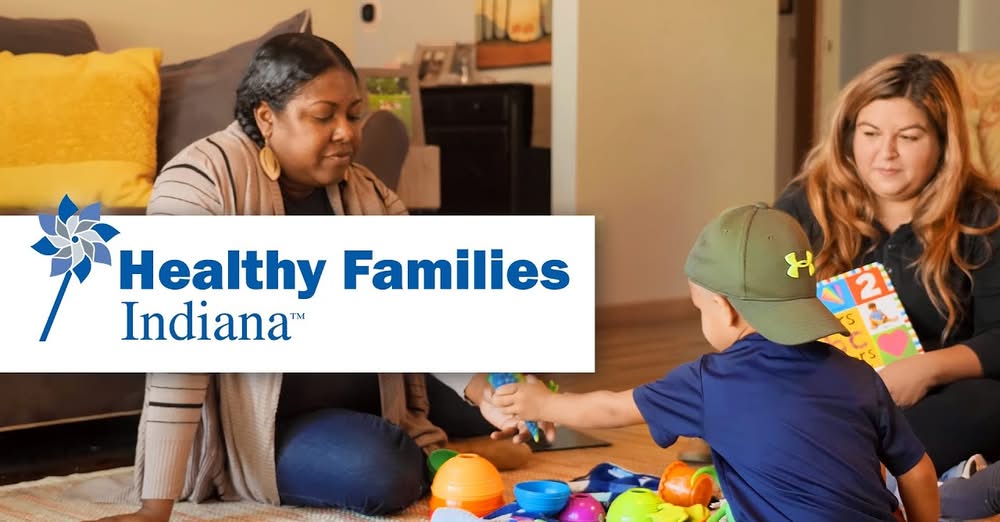
Success in the translation and interpretation space allows staff to do what they do best: connect with families. Staff complete developmental screenings with each family and are able to refer children on to a variety of support services as needed, addressing learning and development gaps and reiterating the importance of early intervention. Staff also model parenting strategies and help families learn and practice new skills.
“It’s so important for our team to demonstrate the relationship that we want the parents to have with their kids, and model those behaviors,” Brown said. “We do that by developing a good relationship with the mom, helping to build her up, being her support system, and being that person that’s going to reinforce all the great things that she’s doing.”
Sometimes results take time. The Healthy Families model is a process, and it can take weeks, months and even years to see impactful change within a family. “Then all of the sudden, it clicks and we can see the changes for the kids,” Brown said. “The parents are more engaged in their learning. They’re getting to the doctor’s appointments, attending to health issues, attending to the child’s development issues. Those are all things that positively impact the child.”
For the families served, Healthy Families leaves a lasting impact. Brown shared the story of one former staff member who retired in 2018. She recently received a text message from a family she had worked with who had 14-year-old twins at the time, sharing a photo of the girls graduating from college. “That gave me chills,” said Brown. “Their children are doing great and they’re doing all these wonderful things out in the world, and they wanted to share that with us. It speaks to the impact this program has on the families and on the children.”
Looking ahead, Brown would love to have the capacity to serve every family referred for services. Although the translation and interpretation services are filling a critical need, Brown still hopes to add bilingual staff members. “There is a certain perspective that you can’t always get through interpretation, and I’d love for us to be able to attract the team members we need to be reflective of the communities we serve,” she said.
In the meantime, the Healthy Families team will continue to support and empower families through any avenue they can find. “We know that early learning time frame of zero-to-three is so critically important,” Brown said. “We’re trying to fit as many positive experiences as we can in there because we know that’s going to positively impact that child throughout the rest of their life.”
No comment yet, add your voice below!